Glacier Hike or Ice Cave Tour in Iceland? How to Choose (or Do Both)

Choosing between a glacier hike or ice cave tour in Iceland is really a choice between two different experiences, not two grades of the same one. A hike keeps you moving on top of the ice, over ridges and past crevasses; a cave tour takes you inside it, into a still blue chamber cut by last summer's meltwater. I guided both on Vatnajökull's outlet glaciers for six winters, and the honest answer for most travelers with limited time is neither alone: a single 4 hour tour does both. If you can only pick one, this is the effort, season and price math to make that call, and where each side genuinely wins.
Quick answer
A glacier hike and an ice cave tour are different products: the hike keeps you moving on the surface among crevasse fields, the cave takes you inside meltwater tunnels for a still, sheltered experience. If you can only pick one in winter, take the cave; in summer, when most caves are closed, take the hike. The Skaftafell combo does both in one 4 hours, and for most first-time visitors, it is the better booking than choosing sides.
Key takeaways
- A glacier hike moves you over crevasse fields on the surface; an ice cave tour takes you inside meltwater tunnels
- Glacier hikes demand more fitness; most cave tours need only a short walk on uneven ground after the vehicle leg
- The Skaftafell combo (tour-4) does both in 4 hours, from $165.22, about 20,500 ISK, minimum age 8
- Vatnajökull's blue caves run roughly November to March; glacier hikes run year-round, and Katla covers summer
- Time on or in the ice: about 45 to 60 minutes inside a cave versus 1.5 or more hours on the ice on a hike
- Bad-forecast days favor the cave, since it sits sheltered at a steady 0°C while a hike gets wind-battered
The Short Answer
If You have limited time and want one clear answer
Book the Skaftafell combo (tour-4): cave and hike in one 4 hour outing
If You are traveling in summer
A hike or the Katla cave, since the Vatnajökull blue caves are closed by then
If You want the strongest photographs
Both, if your schedule allows, since caves give the blue-ice frame and hikes give the scale-and-landscape frame
If You are traveling with kids aged 8 and up
The Skaftafell combo or a cave-only tour; pure glacier hikes ask more of a child's stamina
If Your fitness or mobility is limited
A cave-only tour, since the walking portion is shorter and the terrain more forgiving
Hike vs Cave at a Glance
The two products compared on the points that actually decide most bookings.
| Glacier Hike | Ice Cave | |
|---|---|---|
| Experience | Moving across crevasse fields on the surface | Standing inside a still meltwater tunnel |
| Season | Year-round | Roughly November to March, except Katla, which runs year-round |
| Effort | Higher: sustained walking on uneven, sloped ice | Lower: a short walk on uneven ground after the vehicle leg |
| Time on ice | About 1.5 to 2.5 hours moving on the surface | About 45 to 60 minutes inside the cave itself |
| Typical price | From about $164 (20,300 ISK) when paired with a cave; pure-hike prices vary by operator | From about $161 to $180 (roughly 20,000 to 22,300 ISK), checked August 2026 |
| Minimum age | 8 to 10, depending on the tour | 8 to 10, depending on the tour |
| What you remember | The scale of the ice field and the physical effort of crossing it | The blue light and the stillness of standing inside the glacier |
What a Glacier Hike Actually Involves
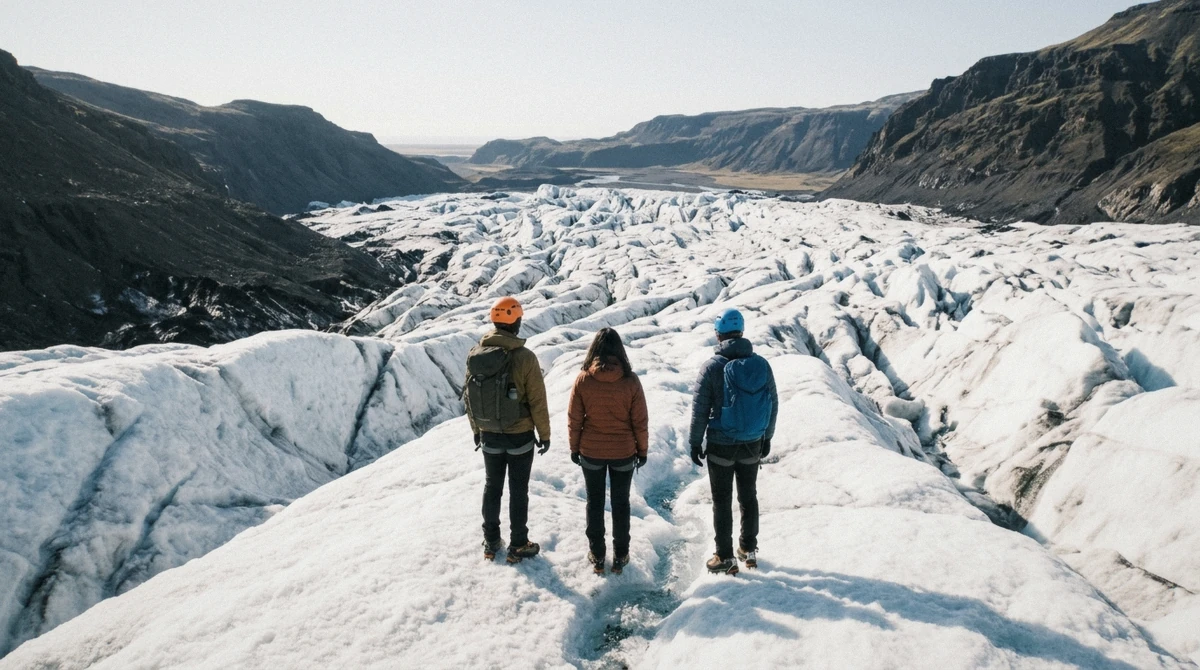
A glacier hike puts you on top of moving ice, crossing ridges, meltwater channels and crevasse fields with crampons and, on some routes, an ice axe, all provided rather than bought. It demands more fitness than a cave tour: sustained walking on ground that is never quite flat, with your balance doing real work the entire time. Nobody who has done both would call it as passive as a ride to a cave mouth.
The honest sweat level is moderate to high depending on the route and how the ice has moved that season. Guides pick a line through the crevasse field that changes week to week, and a longer hike in poor conditions leaves most first-timers genuinely tired by the end, in a good way. This site keeps route-level detail off this page deliberately; if you want a specific trail breakdown, the dedicated hiking guides linked from the combo tour below cover that ground properly, and this post stays focused on the decision itself.
What surprises most first-timers is how much the terrain changes underfoot within a single outing. A section that was a smooth white ramp in December can be a broken field of small crevasses by March, once meltwater has had a season to work through it, which is exactly why guides walk the route fresh every morning rather than relying on a fixed path. None of that makes it dangerous with a guide reading the ice ahead of you, but it does mean a hike asks for a kind of attention a cave tour never does: watching your footing constantly rather than mostly watching the scenery.
The Fitness Question, Honestly
Most complete beginners of average fitness manage a glacier hike without real difficulty, but it is not a passive activity the way a cave visit can be. Expect sustained standing and walking across one and a half to two and a half hours, with occasional short, steeper sections where the guide will slow the pace deliberately. Anyone with knee or hip issues that make an uneven, sloped surface uncomfortable should lean toward a cave tour instead, where the walking portion is shorter and the ground, once inside, is flatter.
What an Ice Cave Tour Actually Involves
A cave tour is more accessible to more people, largely because the vehicle does most of the work. A super jeep or modified 4x4 covers the distance, and the walking portion, once you arrive, is a shorter stretch over uneven ash or ice before crampons go on at the cave mouth itself. Fitness demands are genuinely lower: you need to manage a couple of hours on your feet, not a sustained climb.
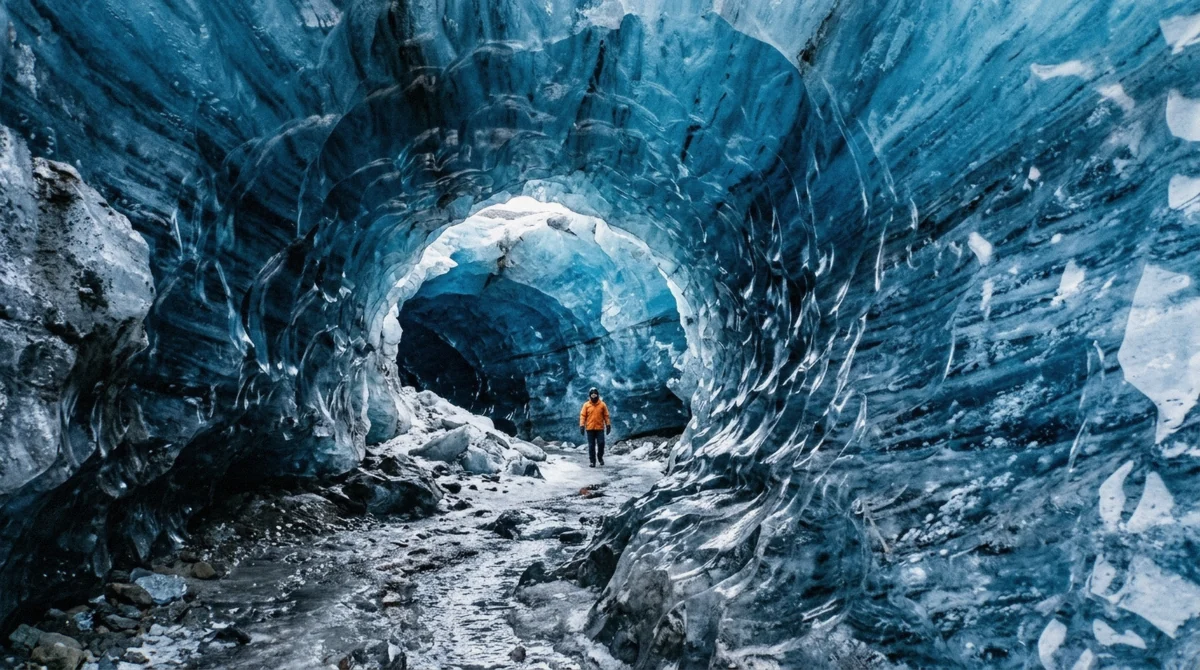
What you get in exchange for the lower effort is a completely different kind of experience rather than a lesser one: standing still inside a chamber cut by meltwater, walls banded blue and sometimes streaked with volcanic ash, holding near 0°C whatever the season outside. It is a quieter, more contained thirty to sixty minutes than anything a hike offers, and it is the part most people photograph the most.
The trade-off runs the other way too. Once you are inside, there is comparatively little to do besides look, listen and photograph, since the chamber itself does not change shape as you move through it the way a crevasse field does underfoot. Some travelers who do both in the same day describe the cave as the calmer, more contemplative half of the outing and the hike as the more physically memorable one, which is part of why the combo below works as well as it does rather than feeling redundant.
The Combo: One Tour That Does Both
The Skaftafell blue ice cave and Falljökull glacier hike (/#tour-4) is the answer this whole post is really building toward. From a base camp near Skaftafell, a 4x4 bus runs twenty minutes to the foot of Falljökull, then you spend about two and a half hours actually on the ice: crossing ridges and moulins before reaching a blue cave at the end of the walk. Four hours total, from $165.22, about 20,500 ISK at 1 USD ≈ 124 ISK, checked August 2026, minimum age 8, with a twelve-person cap per guide.
For most travelers who cannot justify booking both a dedicated hike and a dedicated cave tour on the same trip, this is the one to book. You get the crevasse-field walking that makes a hike worth doing and the still blue chamber that makes a cave worth doing, in a single half-day outing rather than two separate bookings on two separate days.
Season Changes the Answer
Vatnajökull's natural blue caves run roughly from November to March, closed the rest of the year by summer melt, while glacier hikes run year-round regardless of season. Katla, under Mýrdalsjökull, is the one natural cave that stays open through summer, which is why it carries most of the warm-season cave bookings on this site. If your trip lands outside the cave window, which caves are open the month you travel walks through the full season-by-season breakdown.
Price per Hour on the Ice
Priced by the hour actually spent on or in the ice, a hike buys more ice time per dollar than a cave-only tour, since the walking portion runs longer than the time inside a chamber.
| Tour | Total price | Time on or in ice | Rough price per hour |
|---|---|---|---|
| Vatnajökull cave and glacier walk (tour-6) | $164, about 20,300 ISK | About 1.5 hours guided walking plus cave time | Around $95 to $110 |
| Skaftafell combo (tour-4) | $165.22, about 20,500 ISK | About 2.5 hours on Falljökull plus the cave | Around $60 to $70 |
| Two-day south coast with a blue cave (tour-7) | $728.09, about 90,300 ISK | About an hour inside the cave, plus a full second day on the coast | Depends heavily on how you count the second day |
The gap holds up: the combo delivers the most ice time per dollar of any single-day option here, which is the arithmetic behind the recommendation above. The two-day trip looks expensive by comparison until you count what it actually buys, a full extra day on the south coast plus a longer cave visit, rather than judging it purely on cave minutes. If you are weighing Reykjavík pickup against a cave-side meeting point, ice cave day trips from Reykjavík covers that separate price gap in full, since pickup tours generally run higher than meeting the guide near the ice itself.
Verdict: Which to Book
For a first-time visitor with one day to spare, the Skaftafell combo (/#tour-4) is the call, cave and hike together, minimum age 8. For a traveler who wants the biggest single review count and a meeting point right at the lagoon, the Vatnajökull cave and glacier walk (/#tour-6) covers both in three hours. For anyone who wants to slow the whole thing down, sleep near the ice, and get closer to a full hour inside the cave instead of thirty minutes, the two-day south coast trip (/#tour-7) is worth the extra cost.
A traveler set on a pure glacier hike with no cave at all is genuinely better served looking at a dedicated hiking operator than any tour on this page, since every option here pairs some amount of hiking with cave time by design. That is a deliberate scope decision, not an oversight: this site's tours all lead to a cave eventually, and a reader who wants ice time with no cave attached should say so to the operator directly when booking.
Weather honesty matters here too. Hikes get wind-battered and views vanish into cloud on a bad-forecast day; caves sit sheltered at a steady 0°C regardless of what the sky is doing outside, which is the practical reason to default to the cave when the forecast looks rough. Whichever way you lean, our full list of ice cave and glacier day tours in Iceland is the place to compare departure times before you book.
Hike or Cave: Common Questions
Is a glacier hike harder than an ice cave tour?
Yes. A hike asks for sustained walking on uneven, sloped ice for an hour and a half or more, while most cave tours only require a shorter walk over uneven ground after the vehicle leg. Neither is technical, but the hike is the more physically demanding of the two.
Can I do a glacier hike and an ice cave on the same day?
Yes, most directly through the Skaftafell combo tour, which pairs a Falljökull glacier hike with a blue ice cave in one 4 hour outing rather than two separate bookings.
Which is better for photographs, a hike or a cave?
They photograph differently rather than one being better. Caves deliver the blue-ice frame that shows up in most Iceland photo galleries; hikes deliver the scale and landscape shots of the ice field itself. The combo tour covers both memory cards in one outing.
Are glacier hikes available in summer when the caves are closed?
Yes. Glacier hikes run year-round regardless of season, unlike Vatnajökull's natural blue caves, which close roughly from April through October due to summer melt. Katla is the exception among the caves and stays open through summer.
Do I need previous hiking experience for a glacier hike?
No, though a hike is more physically demanding than a cave tour and asks more of your legs and balance over a longer stretch of uneven, sloped ice. Guides set the pace and provide crampons and, on some routes, an ice axe.
Is the combo tour worth it compared to booking a cave and a hike separately?
For most travelers, yes. The combo delivers more ice time per dollar than a cave-only tour and skips the cost and logistics of arranging two separate bookings on two separate days.
There is no wrong answer between a glacier hike or ice cave tour in Iceland, only a trade-off between effort and stillness that most travelers do not need to make at all. If you want the simplest version of that decision, book the Skaftafell combo and get both. If your dates only allow one, let the season and the forecast decide for you rather than a preference formed before you ever left home.