Your First Ice Cave Tour in Iceland: What to Expect, Step by Step
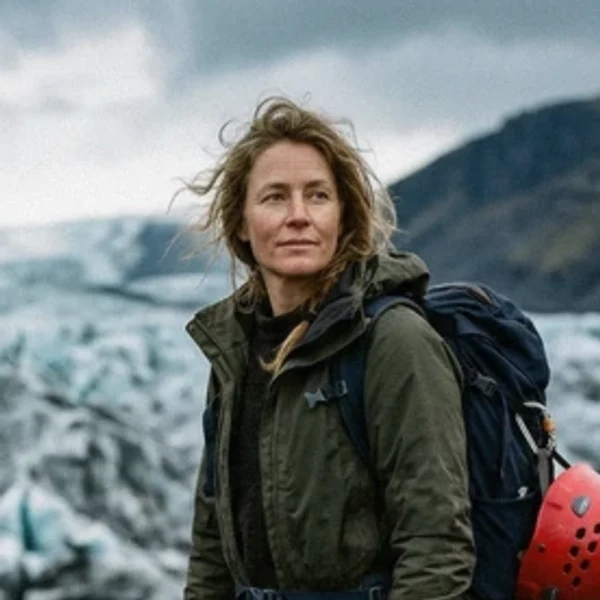
You do not need any experience for your first ice cave tour in Iceland, and you do not need to be especially fit either. I guided these caves on Vatnajökull for six winters, and almost every first-timer worries about the same three things: the cold, walking on uneven ice, and looking foolish in front of a group of strangers. My own first time inside a blue cave, long before I held the rope myself, I was convinced I would slip in front of everyone. Ten minutes in, wrapped in that quiet blue light, the worry had simply gone. What follows is the walkthrough I wish someone had handed me before that first trip, the booking, the ride in, the 45 minutes inside, and every worry in between.
Quick answer
No experience is needed for a first ice cave tour in Iceland. You will be inside the cave itself for about 45 to 60 minutes, with the full outing, gearing up and the approach included, running roughly 2.5 to 4 hours. Guides provide crampons, a helmet and a headlamp; you bring warm waterproof clothing and sturdy boots.
Key takeaways
- No prior glacier experience is needed, just the ability to walk on uneven ground for a couple of hours
- Operators provide crampons, a helmet and a headlamp; you bring your own warm waterproof clothing and boots
- Time inside the cave runs about 45 to 60 minutes; the full cave-side tour is roughly 2.5 to 4 hours
- Since November 2024, lead guides in Vatnajökull National Park assess every cave every morning, so a changed plan is normal, not a warning sign
- The most common first-timer mistake is expecting a private, cathedral-shaped cave to yourself
- The Skaftafell combo (tour-4) is the easiest first booking for most people, cave and glacier hike in one 4 hour outing
Do You Need Any Experience or Fitness?
No prior glacier experience is needed, and nobody expects you to know how to walk in crampons before you arrive. The guide fits your gear, explains how to plant your feet in spikes, and stays close for the first few minutes until it becomes automatic, which it does quickly. Equipment does most of the technical work: crampons bite into ice that would otherwise be unwalkable, and a helmet handles the odd low ceiling inside the cave.
The real requirement is fitness of a modest kind. Cave-side tours involve walking on uneven ash and ice for a couple of hours in total, sometimes over ridges and gravel, rarely on flat ground for long. Anyone comfortable with a two-hour countryside walk manages it without trouble. Where people genuinely struggle is footing, not stamina: loose gravel on the approach, an ankle that rolls on an unfamiliar ice ridge, or a knee that does not love a slow uphill return. None of that rules a first-timer out, it just means the boots you wear matter more than the gym sessions you skipped.
Who Should Think Twice
If standing and walking for two hours in cold weather is genuinely difficult for you, the Langjökull ice tunnel is the gentlest option, a flat man-made corridor rather than a natural approach over uneven ground. Anyone with balance issues serious enough to worry about a rutted gravel track, or a medical condition that makes cold exposure risky, should check with a doctor before booking any of these tours; our guide's honesty layer on glacier hike or ice cave covers the fitness gap between the two products in more detail.
What Happens on the Day: Step by Step
The chronology below is the standard rhythm of a cave-side tour, using the Katla super jeep trip as the concrete example since it is the one I guided most often.
| Stage | How long | What happens |
|---|---|---|
| Booking and the night before | - | Confirmation email with a meeting point and time; little to prepare beyond a warm layer |
| Check-in | 10 to 15 minutes | Meet the guide, sign a waiver, gear handed out or checked against your own boots |
| The ride in | About 40 minutes by super jeep | Off-road on a rural track into the highlands, then a roughly 20-minute walk over the ash flats to the cave mouth |
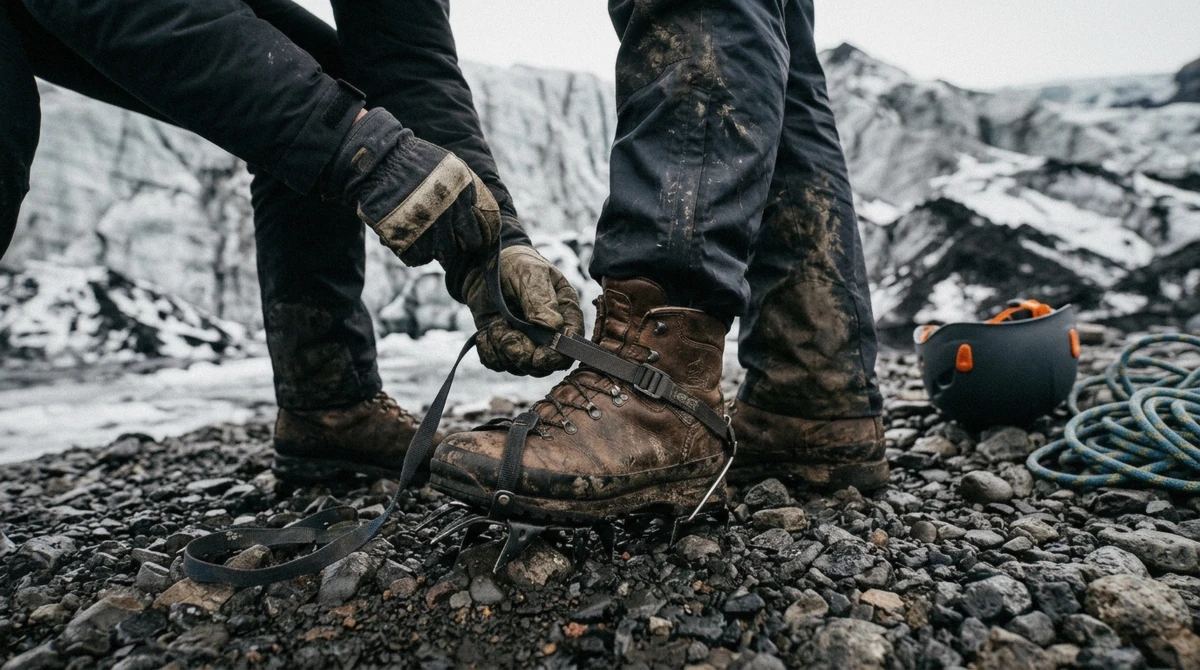
| Gearing up | 5 to 10 minutes | Crampons strapped on at the cave entrance, helmet and headlamp fitted |
| Inside the cave | 45 to 60 minutes | Guided walk through the chamber, photo stops, the guide explains how the ice formed |
| Back out | About 1 hour | Ash flats, super jeep, and the return drive to the meeting point |
Booking and the Night Before
A confirmation message arrives with a meeting time and point, usually a parking area or a fixed address in town rather than your hotel. There is genuinely little to prepare the night before: lay out a warm base layer, charge your camera or phone, and check the forecast so you know whether to add a second layer under your jacket.
Check-In
For the Katla super jeep tour (tour-5), check-in happens at the Icewear and Krónan parking area on Austurvegur in Vík, ten to fifteen minutes before departure. A guide runs through the waiver, checks that your boots are sturdy enough, and hands out any gear you did not bring yourself. Other tours meet at a base camp hut or directly at a car park near the ice, but the shape is the same everywhere: a short administrative stop before the vehicle leg begins.
The Ride In
On the Katla tour, a 4x4 super jeep leaves Vík and drives about 40 minutes up a rural track into the highlands below Mýrdalsjökull. From the drop point it is a 20-minute walk over ash flats to reach the cave mouth, flat enough that no crampons are needed yet. Other operators run this leg differently: the Skaftafell combo uses a shorter 20-minute off-road bus ride before the glacier hike begins, and the Jökulsárlón-based tours drive a modified 4x4 directly onto the glacier itself.
Whichever tour you book, this is the part where the landscape stops looking like a road trip and starts looking like the highlands.
Gearing Up
At the cave entrance, or at the glacier edge for the hiking tours, crampons go on over your own boots, a helmet is fitted, and a headlamp is checked. This takes five to ten minutes and the guide does most of the fiddly strap work themselves, since a loose crampon is the single most common cause of a stumble on the ice.
Inside the Cave
This is the part everyone books the tour for, and it runs about 45 to 60 minutes. The guide leads the group through the chamber at a slow, deliberate pace, stopping for photographs and explaining how the meltwater carved the tunnel the previous summer. Nobody rushes this part.
Heading Back
The return leg mirrors the way in: ash flats or glacier surface, then the vehicle, and roughly an hour back to the meeting point. Most cave-side tours are done in three to four hours total, gate to gate, and there is no formal tipping norm in Iceland since service is already built into the price.
What It Actually Feels Like Inside
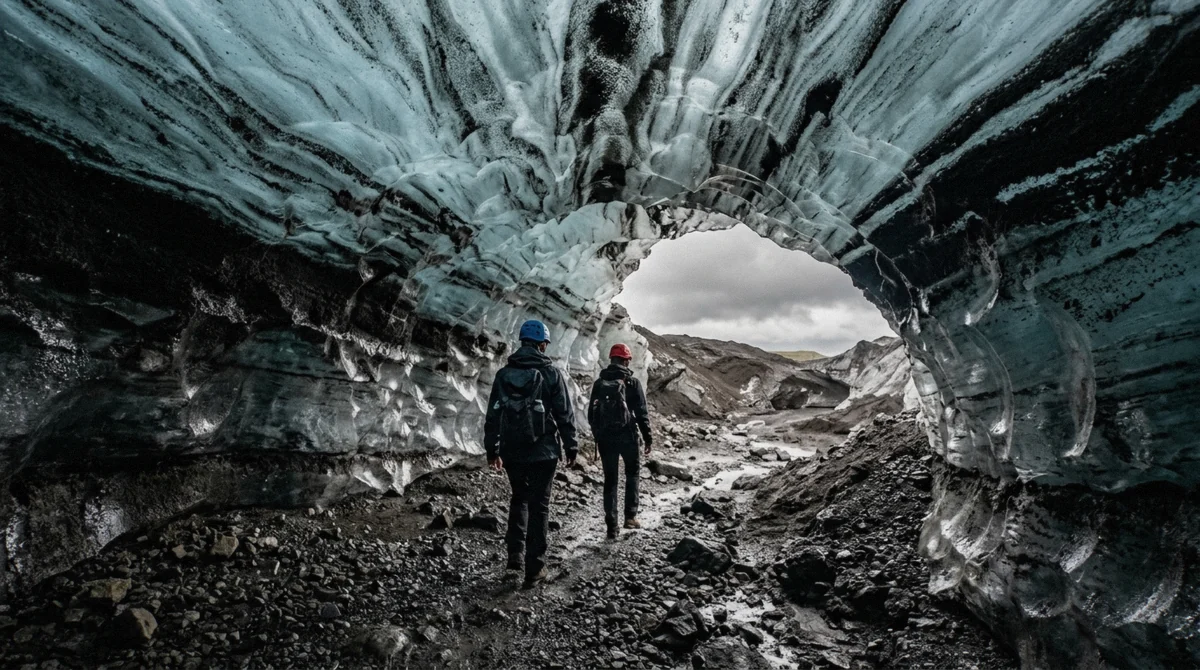
The temperature is the first thing that registers. It holds near 0°C year-round inside the cave, which in winter often feels milder than the wind you just walked in from, and in summer feels like a welcome drop from the ash flats outside. Meltwater drips steadily somewhere you cannot quite see, a background sound that never fully stops even in the coldest months. Light enters only from the mouth of the cave and from headlamps, so the blue deepens the further in you walk, banded in places with dark volcanic ash that ripples through the ice like a growth ring.
Sound behaves strangely in there too. Voices flatten and carry less than you would expect, so a group of ten can feel quieter inside the cave than it did standing outside it a few minutes earlier. The floor underfoot shifts from packed ash to slick ice and back within a few steps, which is exactly why the crampons stay on the whole time even once you are inside and no longer climbing anything.
One honest thing worth knowing before you go: you will very likely share the cave with other groups, particularly at Jökulsárlón, where several operators run the same feature on a rotation. Nobody promises you a private, cathedral-shaped chamber to yourself, and the tour listings for the original crystal cave tour (tour-1, from $161, about 20,000 ISK at 1 USD ≈ 124 ISK, checked August 2026) say as much directly. The Katla cave, kept to its own operator, is the closest thing to an exclusive booking among the tours on this site.
Photography is a little different from the postcards. Caves are darker than the marketing photos suggest, since those are usually long-exposure shots taken with a tripod. A phone camera does fine near the entrance where daylight still reaches, but further in you are relying on the group's headlamps, and a tripod slows the whole group down on a narrow path, so most guides discourage setting one up mid-cave.
Nervous? What First-Timers Worry About
Every group I guided had at least one person who arrived quiet and left talking the whole way back. These are the worries that come up most.
| Worry | The reality | What helps |
|---|---|---|
| Will I slip and fall on the ice? | Crampons bite far better than most first-timers expect, and the guide sets a slow pace on any uneven stretch | Plant your whole foot, not just the toe, and take the guide's lead on where to step |
| Is it going to feel claustrophobic? | Most cave chambers are tall enough to stand upright in, and the entrance stays visible or close behind for most of the walk | You can always ask to hang back near the entrance rather than go to the far end |
| What about the 2024 collapse, is this actually safe to do? | Since November 2024, lead guides in Vatnajökull National Park assess every cave every morning, and any site judged unsafe stays closed that day | Ask your guide at check-in what the day's assessment found; they will tell you plainly |
| Will the cave I booked even be open? | Guides make the go or no-go call every morning, and caves can be swapped without notice | Treat a last-minute swap as normal flexibility, not a defect in the product |
| Will the cave really look like the cathedral photos I saw online? | Shape and size change with the season, and shared caves in particular are not guaranteed to look like any specific photo | Book the Katla or Skaftafell tours if a less-shared chamber matters more to you than convenience |
None of this is a safety statistic to memorize, it is just what actually happens when the worry surfaces. Most first-timers stop thinking about any of it within the first ten minutes inside, and the ones who arrive quiet are usually the ones who cannot stop talking about it on the ride back.
What to Wear and Bring: the Short Version
Waterproof, insulated hiking boots with ankle support are the one item that actually matters, since crampons need a stiff sole to grip properly. Underneath that, dress in layers rather than one thick coat: a base layer, a warm mid layer, and a waterproof windproof shell on top. Gloves and a hat are essential even in summer, since the ride in is often the coldest part of the day.
Operators provide crampons, helmets and headlamps, so none of that needs to come from your own closet. The full inclusion list for a specific tour, including what to rent on site if you arrive without boots, is set out on the Skaftafell hike and cave tour page.
First-Timer Mistakes to Avoid
Small things that make the biggest difference on the day.
- Wearing cotton jeans, which soak through and stay cold for the rest of the tour
- Showing up in sneakers or trainers, which crampons cannot grip properly
- Booking the ice cave for the last day of the trip, when a weather delay has nowhere to reschedule to
- Expecting a private, cathedral-shaped cave to yourself, especially on the more-shared Jökulsárlón tours
- Ignoring the minimum age listed for a tour, then discovering it at check-in with a child in tow
- Packing a tripod for the cave interior, which slows the whole group on a narrow path
- Skipping gloves because the forecast says mild, then regretting it on the ride in
Which Tours Suit a First Ice Cave
Three tours on this site suit a genuine first-timer best, each for a slightly different reason.
- Jökulsárlón blue ice cave with the original glacier operator (/#tour-1), from $161, 3 hours, minimum age 10: the shortest walk of the three, meeting right at the lagoon rather than a highland drive. Honest about sharing the cave and about the shape not being guaranteed, which is exactly the kind of first-timer expectation this guide is trying to set.
- Skaftafell blue ice cave and Falljökull glacier hike (/#tour-4), from $165.22, about 20,500 ISK, 4 hours, minimum age 8: adds a Falljökull glacier hike before the cave, which means more time on the ice overall and a small-group cap that suits a nervous first walk in crampons.
- Katla ice cave by super jeep from Vík (/#tour-5), from $180.03, about 22,300 ISK, 3 hours, minimum age 8: the tour this whole walkthrough is built around, and the one where the cave is not shared with other operators.
First-Timer Questions
Do I need any experience before my first ice cave tour?
No prior glacier experience is needed. Guides fit your crampons, explain the footing, and set a pace that works for a first-timer. You just need to be comfortable walking on uneven ground for a couple of hours.
What if I get nervous and want to stop partway through?
Say so to the guide. On the walk to and from the cave, you can pause or hang back near the entrance rather than continue to the far end. Guides handle this constantly and would rather you speak up than push through discomfort quietly.
Will I be the only first-timer on the tour?
Almost certainly not. Most groups on the shared cave tours are a mix of first-timers and repeat visitors, and nobody is expected to have done this before. The briefing at check-in covers everyone equally.
How far ahead should I book my first ice cave tour?
A few days ahead is usually enough outside the busiest weeks, though booking further out gives you first choice of departure time, which matters more for weather flexibility than for availability itself.
Can I use my phone to take photos inside the cave?
Yes, near the entrance where daylight still reaches. Further inside, a phone camera relies on the group's headlamps and will look darker than the long-exposure photos you have seen online; a tripod is impractical on the narrow path and slows the whole group.
What happens if my assigned cave is closed the morning of the tour?
Since November 2024, lead guides in Vatnajökull National Park assess every cave every morning, and guides make the go or no-go call before you leave. If a site is closed, the tour runs to an alternative cave or a glacier walk instead, not cancelled outright.
Nothing about a first ice cave tour in Iceland requires prior experience, unusual fitness, or gear you do not already own. The nerves that show up beforehand, the cold, the footing, looking foolish in front of strangers, tend to fade within the first ten minutes for nearly everyone. If you are still weighing a cave against a glacier hike, glacier hike or ice cave walks through the honest trade-offs, and which caves are actually open the month you travel is worth checking before you commit to a date.
When you are ready, book an ice cave day tour and start with whichever of the three above suits your nerve and your schedule.